
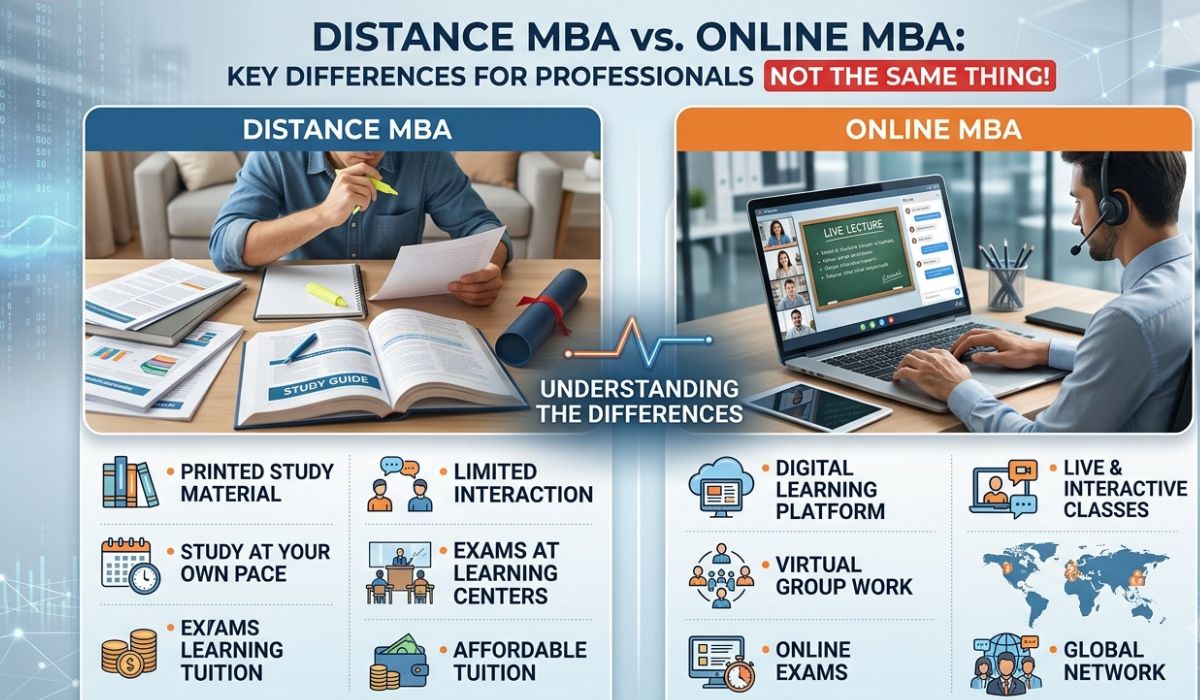
The difference affects how you study, how you appear for exams, how much support you get, and how much time you will need each week. This guide explains both formats in plain language so you can choose with confidence.
What is a Distance MBA?
A distance MBA (also called an ODL, or Open and Distance Learning, MBA) is the traditional form of remote management education in India. You are enrolled with a university but do not attend regular classes. Typically you get:
- Printed or digital study material
- Assignments (internal assessment) submitted during the semester
- Term-end exams, often at designated exam centres
- A project report or synopsis in the final stages
It suits self-driven learners who prefer to study at their own pace. Programs from universities such as SCDL, SSODL and IGNOU follow this broad model. If you are new to the format, our guide on what distance learning is covers the basics.
What is an Online MBA?
An online MBA is delivered through a digital learning platform (LMS). It is more structured and technology-driven than a distance MBA. Typically you get:
- Recorded video lectures, and sometimes live or interactive sessions
- Digital study material, quizzes and discussion forums
- Online or remote-proctored exams that you can take from home
- Online assignments, case studies and a capstone or project
It suits learners who want guided instruction, a regular schedule and more interaction with faculty and peers. Several university programs, including those from NMIMS, Amity and IMT, are delivered in this online format.
Distance MBA vs Online MBA: Side-by-Side Comparison
| Factor | Distance MBA | Online MBA |
|---|---|---|
| Delivery | Study material, self-paced | LMS with video lectures and digital content |
| Live interaction | Limited or optional | Often available (live sessions, doubt-clearing) |
| Exams | Mostly centre-based, pen-and-paper in many programs | Usually online or remote-proctored |
| Assignments | Submitted periodically | Often online, with deadlines inside the LMS |
| Flexibility | Very high, with fewer fixed schedules | High, but with more deadlines and sessions |
| Learning style | Self-study | Guided and structured |
| Tech requirement | Basic | Stable internet and a laptop are essential |
| Fees | Generally lower | Generally higher |
| Networking | Minimal | Better (peer groups, webinars) |
Details vary by university and change from session to session, so always check the current prospectus.
Which One Is Right for You?
Choose a Distance MBA if:
- You have an unpredictable work schedule and want maximum flexibility
- You are comfortable studying independently from material
- Budget is a major factor
- You live where internet access is inconsistent
Choose an Online MBA if:
- You learn better from lectures than from books
- You want faculty interaction and peer networking
- You prefer a clear weekly structure to stay on track
- You are comfortable with online exams and digital tools
The Question Most Students Forget: Is the Program Recognized?
Whichever format you pick, check these before paying any fee:
- UGC-DEB approval. Confirm the university has current approval to offer that specific program in that specific mode. Rules and approvals change, so verify on the official UGC-DEB website rather than relying on an advertisement.
- Program-specific recognition. Approval for one course does not automatically cover another.
- Employer acceptance. If you are aiming for a promotion or a job switch, ask your HR team or check how recruiters in your field view that university.
Challenges You Should Expect in Either Format
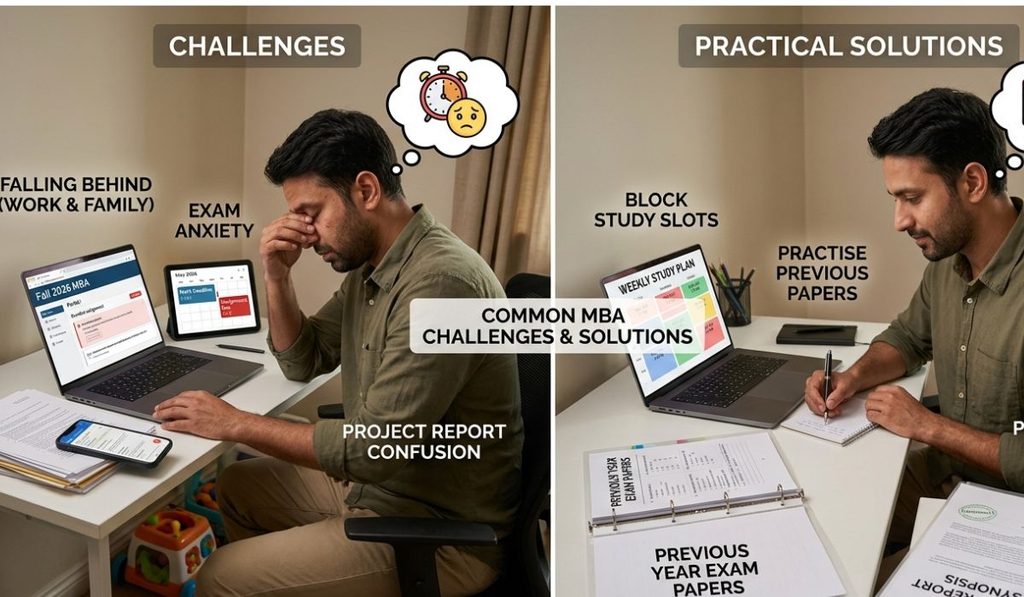
Both formats share the same real-world problem: studying alongside a job and family. Common struggles include:
- Falling behind on assignments because work eats up weekday evenings
- Exam anxiety, especially for students who have been out of academics for years
- Project report confusion, from choosing a topic to getting the structure right
Some practical ways to handle these:
- Block fixed weekly study slots. Our post on time management for distance learning students shows how.
- Practise with previous year papers so you understand the exam pattern before test day.
- Start your project report early, and get the structure and synopsis approved before you begin writing.
How Navkim Solutions Can Support You
Whichever mode you pick, you will need good reference material, practice and guidance. Navkim Solutions has supported distance and online learners since 2002 with university-specific resources for SCDL, IMT, Amity, LPU and more. For example, students in the NMIMS online MBA can use our NMIMS assignment support as a study reference to understand answer structure, presentation and exam patterns, then write in their own words. That keeps your work original and your learning real.
FAQs
Is an online MBA better than a distance MBA?
Neither is automatically better. The better choice depends on your learning style, schedule and budget, and on whether the program is recognized.
Are distance and online MBAs valid for jobs?
They can be, if the university and program carry valid UGC-DEB approval. Always verify current status before enrolling. Employer perception also varies by industry and university.
Can I do an MBA while working full time?
Yes. Both formats are designed for working professionals. The key is consistent weekly study time.
Which is cheaper, distance or online MBA?
Distance programs are generally less expensive, but fees vary widely by university, so compare the full program cost, not just the first-semester fee.
Are exams easier in online MBA programs?
Not necessarily. Online exams are often time-bound and application-based, so practising with solved papers and sample questions matters in both formats.
Final Verdict
There is no universally “better” option. A distance MBA gives you flexibility and a lower cost, if you are disciplined. An online MBA gives you structure, interaction and a more modern learning experience, if you can commit to the schedule.
Ask yourself three questions: How do I learn best? How predictable is my schedule? What is my budget? The honest answers will point you to the right program.