
If you are pursuing an MBA or any postgraduate programme through Amity Global Access School for Continuing Education (NGA-SCE), your Amity Assignments 2026 are not just a formality—they are a critical component of your final grade, internal assessment score, and ultimately your degree outcome. This comprehensive Amity Assignments Guide is designed to help you understand every aspect of the assignment process. Yet every semester, thousands of Amity students find themselves asking the same questions: What exactly is expected in these assignments? How are they evaluated? What is the submission deadline? How can previous year question papers improve your preparation? And what strategies can help you consistently score above 80%? This guide answers all these questions with practical tips, expert insights, and step-by-step guidance to help you perform confidently in every semester.
This guide answers every one of those questions in one place. Whether you are a Semester 1 fresher trying to understand the system for the first time, or a Semester 3–4 student looking to improve your scores, this complete guide to Amity Assignments 2026 is built for you.
By the end of this article, you will understand the full assignment lifecycle — from question paper release to final submission — along with proven strategies to write answers that score, format project reports correctly, and use solved papers and previous year questions effectively.
What Are Amity Assignments and Why Are They Important?
Amity assignments are compulsory written submissions that form part of the Internal Assessment (IA) component of every subject in the Amity distance and online MBA programme offered through NGA-SCE.
The Role of Assignments in Your Final Score
Under the Amity evaluation framework, your final subject grade is divided between:
- Internal Assessment (IA): 30 marks (assignments contribute significantly here)
- End-Term Examination: 70 marks
This means your assignment performance directly affects 30% of your total marks in every subject. For students who struggle in exams, strong assignment scores can be the difference between a pass and a distinction. For students who perform well in exams, good assignments create a buffer that protects your grade.
What Topics Do Assignments Cover?
Amity assignment questions are designed to test applied understanding — not just textbook recall. Each set of questions typically requires you to:
- Apply management theories to real-world business scenarios
- Analyse case studies from Indian and global organisations
- Demonstrate critical thinking and structured reasoning
- Show awareness of current business trends and industry practices
This is why generic or copied answers consistently score poorly, while well-reasoned, original responses regularly score 8–10 out of 10 per question.
Who Issues Amity Assignments?
Assignments are issued directly by Amity Global Access School for Continuing Education through the official student portal. Each semester, a fresh set of assignment question papers is released for all subjects, and students must submit their answers before the declared deadline.
Amity Assignment Answers 2026: How to Prepare High-Scoring Submissions
Preparing Amity Assignment Answers that score well is a skill — and like all skills, it can be learned and systematised.
Understand the Question Before You Write
The most common reason for low marks is answering what you assumed the question was asking rather than what it actually asked. Before writing a single word:
- Read the question at least twice
- Identify the command word: “Explain,” “Analyse,” “Evaluate,” “Discuss,” “Compare,” “Recommend”
- Identify the subject: What concept, theory, or scenario is being addressed?
- Note the scope: Is this a general answer or does it require application to a specific case or industry?
Structure Every Answer
A high-scoring Amity assignment answer consistently follows a clean structure:
- Introduction (2–3 sentences): Define the concept or set the context of the question
- Main Body: Present your analysis, arguments, or case application in 3–5 paragraphs
- Conclusion (2–3 sentences): Summarise your key point or recommendation
- Word count: Most answers should be 350–500 words unless specified otherwise
Use Real Business Examples
Examiners award higher marks when students demonstrate that they understand concepts in a real-world context. Always support your answers with:
- Named companies (Tata, Infosys, Amazon, Unilever, Reliance, etc.)
- Specific events or business decisions
- Current trends relevant to the subject (digital transformation, sustainability, post-pandemic strategy, etc.)
Cite Relevant Theories and Frameworks
Where applicable, name and apply the relevant management frameworks:
- Marketing: STP, 4Ps/7Ps, Porter’s Five Forces
- Finance: Ratio Analysis, Capital Budgeting, WACC
- HR: Maslow, Herzberg, Competency Models
- Strategy: SWOT, PESTLE, BCG Matrix, Ansoff Matrix
- Operations: Just-in-Time, Six Sigma, Supply Chain Models
Using frameworks correctly — and applying them to your answer’s scenario — is one of the clearest signals of a strong student.
Avoid Plagiarism Absolutely
Amity has a strict plagiarism policy. Assignments found to contain copied content from the internet, textbooks, or other students’ submissions are awarded zero marks and may be flagged for disciplinary action. Every submission must be original.
Amity MBA Assignment Questions and Marking Pattern
Understanding how Amity MBA Assignments are structured and how marks are distributed helps you allocate your time and effort intelligently.
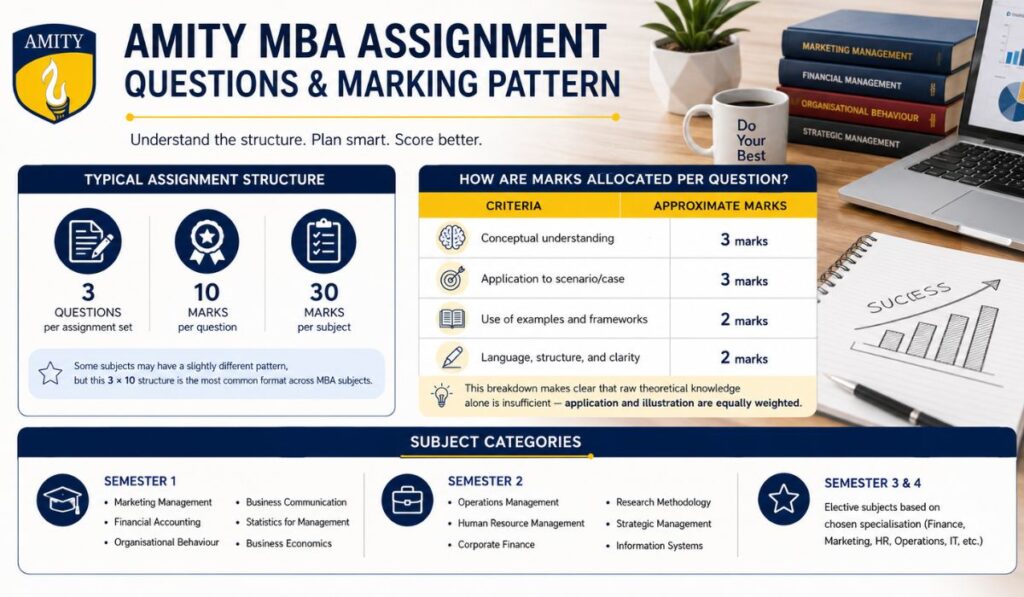
Typical Assignment Structure
Each Amity subject assignment generally contains:
- 3 questions per assignment set
- 10 marks per question
- Total: 30 marks per subject
Some subjects may have a slightly different pattern, but this 3 × 10 structure is the most common format across MBA subjects.
How Are Marks Allocated Per Question?
Within each 10-mark question, evaluators typically assess:
| Criteria | Approximate Marks |
| Conceptual understanding | 3 marks |
| Application to scenario/case | 3 marks |
| Use of examples and frameworks | 2 marks |
| Language, structure, and clarity | 2 marks |
This breakdown makes clear that raw theoretical knowledge alone is insufficient — application and illustration are equally weighted.
Subject Categories
Amity MBA assignment questions span a wide range of subjects including:
Marketing Management, Financial Accounting, Organisational Behaviour, Business Communication, Statistics for Management, Business Economics
Operations Management, Human Resource Management, Corporate Finance, Research Methodology, Strategic Management, Information Systems
Elective subjects based on chosen specialisation (Finance, Marketing, HR, Operations, IT, etc.)
Amity Assignment Submission Last Date and Important Deadlines
Missing the Amity Assignment Submission Last Date is one of the most avoidable academic mistakes — and one of the most damaging. Late submissions are typically awarded zero marks with no exceptions.
How the Academic Calendar Works
Amity follows a semester-based academic calendar. Each semester, the assignment cycle follows this general pattern:
- Assignment Question Paper Release: Approximately 6–8 weeks before the submission deadline
- Submission Window: Students have 4–6 weeks to complete and submit
- Hard Deadline: Strictly enforced — no extensions are typically granted
- Result Declaration: After the end-term examinations
Where to Check Your Submission Deadline
Always check your deadline directly on the official Amity student portal (Amity.edu). Do not rely on:
- WhatsApp groups
- Unofficial websites
- Information from seniors (deadlines can shift year to year)
Recommended Personal Deadline
Set your own internal deadline 7 days before the actual submission date. This gives you a buffer for:
- Technical issues with the portal
- Last-minute review and corrections
- Internet connectivity problems
- Any personal emergencies
Consequences of Missing the Deadline
- Zero marks for internal assessment in that subject
- Significant impact on your final grade (30% of total marks lost)
- No provision for supplementary or late submission in most cases
Amity Online MBA Assignments: Complete Student Guide
The Amity Online MBA Assignments system is entirely digital — from question paper download to final submission. Here is the step-by-step process every student must follow.
Step 1: Log In to the Student Portal
Access your Amity student account at the official portal using your registered credentials.
Step 2: Download the Assignment Question Paper
Navigate to the Assignments section and download the current semester’s question paper for each subject.
Step 3: Prepare Your Answers
Write your answers in Microsoft Word format (or as specified). Follow the formatting guidelines provided:
- Font: Times New Roman or Arial, 12pt
- Line spacing: 1.5
- Include your Name, SAP ID, Roll Number, Subject Name, and Programme on the first page
Step 4: Convert to PDF
Before uploading, convert your Word document to PDF to preserve formatting.
Step 5: Upload to the Portal
Upload each subject’s assignment PDF through the designated submission section of the student portal before the deadline.
Step 6: Save Your Acknowledgement
Always save or screenshot the submission confirmation. This is your proof of submission if any dispute arises.
Amity Internal Assessment Guide for MBA Students
The Internal Assessment (IA) at Amity encompasses more than just assignments. Understanding the full IA structure helps you maximise your 30 marks strategically.
Components of Internal Assessment
While assignment submissions are the primary IA component for most subjects, the IA may also include:
- Case Study Analysis: Short written analyses submitted through the portal
- Project Work: In certain subjects, particularly in later semesters
- Participation and Quizzes: On the learning management system (LMS) for some programmes
How to Maximise Your IA Score
- Submit all three assignment questions — never leave one blank
- Aim for 400–500 words per answer (quality matters more than length, but very short answers signal low effort)
- Proofread for spelling and grammar errors before submission
- Use headings and sub-headings within your answers for clarity
- Always write in your own words — paraphrase and apply, never copy-paste
Amity Exam Pattern 2026 Explained
Understanding the Amity Exam Pattern 2026 allows you to align your assignment preparation with your overall examination strategy.
End-Term Examination Structure
| Component | Details |
| Total Marks | 70 |
| Exam Duration | 2 hours 30 minutes |
| Question Format | Theory + Case-based questions |
| Mode | Online proctored exam |
| Passing Marks | As per Amity grading policy |
How Assignment Preparation Helps in Exams
The same frameworks, examples, and analytical skills you develop while writing assignments directly improve your exam performance. Students who write thorough, well-researched assignments consistently outperform those who treat assignments as a formality, because:
- The act of writing consolidates conceptual understanding
- Real business examples used in assignments are equally valuable in exam answers
- Structured writing practice improves speed and coherence under exam conditions
Grading Scale
Amity typically uses a letter-grade system. The combined Internal Assessment (30) + End-Term (70) score determines your final grade band (O, A+, A, B+, B, etc.). Consistently strong IA scores can elevate your grade even when exam performance is average.
Amity MBA Solved Assignments Semester 1
Amity MBA Solved Assignments for Semester 1 cover the foundation subjects that every student must navigate successfully in their first semester.
Key Semester 1 Subjects
- Marketing Management — Consumer behaviour, segmentation, marketing mix, brand strategy
- Financial Accounting & Analysis — Balance sheets, P&L statements, ratio analysis
- Organisational Behaviour — Motivation theories, leadership styles, group dynamics
- Business Communication — Report writing, business letters, presentation skills
- Statistics for Management — Descriptive statistics, probability, hypothesis testing
- Business Economics — Demand-supply, market structures, macroeconomic indicators
How to Approach Semester 1 Assignments
Semester 1 is foundational. Assignment questions in this semester tend to be more definitional and conceptual than in later semesters. Focus on:
- Clearly defining the concept at the start of each answer
- Relating concepts to familiar Indian business examples (Amul’s marketing strategy, Tata’s corporate governance, Infosys’s HR practices)
- Demonstrating that you understand why a concept matters, not just what it is
Amity Solved Assignments Semester 2
Semester 2 Amity Solved Assignments shift toward applied and integrative thinking. The subjects are more analytical and require stronger business reasoning.
Key Semester 2 Subjects
- Operations Management — Process design, capacity planning, quality management
- Human Resource Management — Recruitment, performance management, training, compensation
- Corporate Finance — Capital structure, investment decisions, cost of capital
- Research Methodology — Research design, data collection, sampling, analysis
- Strategic Management — Corporate strategy, competitive advantage, strategy implementation
- Management Information Systems — IT strategy, ERP systems, data management
How to Approach Semester 2 Assignments
By Semester 2, examiners expect a higher degree of analytical sophistication. Assignment answers should:
- Move beyond definitions to analysis and evaluation
- Use strategic frameworks (SWOT, Porter’s Five Forces, Balanced Scorecard) explicitly
- Reference current business challenges (digital disruption, ESG compliance, talent management trends)
- Demonstrate integration across subjects (e.g., linking HR strategy to overall corporate strategy)
How Amity Previous Year Question Papers Help in Exam Preparation
Amity Previous Year Question Papers are among the most underutilised resources available to students — yet they are consistently cited by high scorers as one of their primary preparation tools.
What Previous Year Papers Reveal
- Recurring topics: Certain concepts and frameworks appear in almost every examination cycle
- Question framing patterns: Knowing how questions are typically phrased helps you recognise them faster in the exam
- Depth of answer expected: Previous papers with model answers indicate how much detail is needed per question
- Time allocation guidance: Practising with previous papers under timed conditions builds exam speed
How to Use Previous Year Papers Effectively
- Attempt the paper under real exam conditions (timed, no notes) first
- Then compare your answers with model solutions
- Note every concept you missed or misapplied
- Revise those specific areas before the next practice attempt
- Repeat at least 3–4 previous year papers per subject before the end-term exam
Where to Access Amity Previous Year Papers
The official student portal is the primary source. Additionally, Amity study centres and programme coordinators may provide access to past papers. Be cautious of third-party websites — not all are accurate or up to date.
Amity Solved Papers: Benefits and Best Practices
Amity Solved Papers — previous papers accompanied by model answers or answer keys — serve a different purpose than blank previous year papers. They are particularly valuable for self-assessment and gap analysis.
Benefits of Using Solved Papers
- Benchmark your answers against a model standard before submitting
- Identify knowledge gaps you were not aware of
- Learn answer structure from well-written model responses
- Understand examiner expectations for depth, length, and framework usage
- Build confidence before the actual exam by confirming your understanding is on track
Best Practices
- Use solved papers as a learning tool, not a shortcut — do not copy model answers into your assignments
- Focus on the reasoning in model answers, not just the conclusions
- Adapt model frameworks and examples to your own unique phrasing
- Cross-reference solved papers from multiple sources to identify the best-quality models
Amity Project Report Format and Submission Guidelines
The Amity Project Report is a major deliverable for students in certain specialisations and semesters — particularly in Semester 3 and 4 of the MBA programme. It carries significant marks and requires a higher level of research, structure, and original analysis than regular assignments.
Standard Amity Project Report Structure
A well-formatted Amity Project Report typically follows this structure:
Front Matter:
- Title Page (Student Name, SAP ID, Programme, Subject, Batch, Guide Name)
- Declaration by Student
- Certificate from Guide (if applicable)
- Acknowledgements
- Table of Contents
- List of Tables and Figures
Main Body:
Introduction
- Background of the study
- Statement of the problem
- Objectives of the study
- Scope and limitations
- Research methodology overview
Literature Review
- Review of relevant academic and industry literature
- Theoretical framework
- Gap analysis
Research Methodology
- Research design (qualitative/quantitative/mixed)
- Data collection methods (primary and/or secondary)
- Sampling design and sample size
- Tools for data analysis
Chapter 4 — Data Analysis and Findings
- Presentation of collected data (tables, charts, graphs)
- Analysis and interpretation of findings
Chapter 5 — Conclusions and Recommendations
- Summary of key findings
- Strategic recommendations
- Directions for future research
End Matter:
- References (APA or Harvard format as specified)
- Appendices (questionnaires, raw data, interview transcripts)
Formatting Requirements
| Element | Specification |
| Font | Times New Roman, 12pt (body); 14pt (headings) |
| Line Spacing | 1.5 (body); double spacing between sections |
| Margins | 1 inch all sides (1.5 inch left for binding) |
| Page Numbering | Roman numerals for front matter; Arabic for body |
| Referencing | APA 7th Edition (most common) or as specified |
| Word Count | Typically 8,000–12,000 words |
Common Project Report Mistakes to Avoid
- Weak or vague research objectives
- Literature review that merely summarises without critical analysis
- Insufficient primary data (too small a sample)
- Conclusions that do not connect back to objectives
- Incorrect or inconsistent referencing
- Plagiarism in any chapter — run a Turnitin check before submission
Common Mistakes Students Make
Awareness of the most common errors helps you systematically avoid them.
Mistake 1: Copying from Online Sources
The single most penalised error. Amity runs plagiarism checks on all submissions. Even paraphrasing too closely can trigger a flag. Write in your own voice.
Mistake 2: Writing Only Theory with No Application
Answering “What is the BCG Matrix?” with a textbook definition and no real-world application typically scores 4–5 out of 10. Answering it with a clear definition plus an analysis of how a named company uses it typically scores 8–9.
Mistake 3: Ignoring the Question’s Actual Demand
A question asking you to “evaluate” requires pros, cons, and a judgement. A question asking you to “recommend” requires a clear stance. Misreading command words is a major source of avoidable mark loss.
Mistake 4: Submitting Incomplete Assignments
Some students submit answers to 2 out of 3 questions, assuming partial submission is acceptable. It is not — each unanswered question is awarded zero.
Mistake 5: Poor Formatting and Presentation
Walls of unbroken text, missing student details on the cover page, incorrect font or spacing — these signal carelessness and affect the evaluator’s perception of your work even before they read a word.
Mistake 6: Last-Minute Submission
Submitting on the final day risks portal downtime, upload errors, and internet issues. Students who submit late due to technical problems on the deadline day rarely receive any grace or accommodation.
Tips to Score Higher Marks in Amity MBA Assignments
These are the strategies consistently employed by students who score 25–30 out of 30 in their IA assessments.
- Start early: Begin drafting answers within the first week of the question paper release
- Research before writing: Spend 30 minutes reading about the topic before writing — it dramatically improves the quality of your analysis
- Use the PEEL structure: Point, Evidence, Explanation, Link — for each paragraph
- Name your sources: Citing a specific Harvard Business Review article, a named industry report, or a real company case instantly elevates the credibility of your answer
- Proofread twice: Once for content and logic; once for spelling, grammar, and formatting
- Get peer feedback: Ask a classmate to read your answers before submission — a fresh pair of eyes catches errors you miss
- Maintain a personal answer bank: After each semester, save your assignment answers. They become revision material and a reference for future semesters
- Study the marking criteria: If your programme coordinator shares the evaluation rubric, study it carefully — it tells you exactly what the examiner values
FAQ – Amity Assignments Guide
Q: What is the word limit for Amity assignment answers?
A: Amity does not always specify a hard word limit, but most answers are expected to be 350–500 words. Some subjects with analytical or case-based questions may require 500–700 words. If a word limit is specified in the question paper, follow it precisely.
Q: Can I submit Amity assignments after the last date?
A: Generally, no. Amity has a strict no-late-submission policy. The portal closes at the deadline and does not accept uploads after that point. In extraordinary circumstances (medical emergency with documentation), students may request consideration from the programme office — but this is not guaranteed.
Q: Are Amity assignments the same for all students in a batch?
A: Yes. All students enrolled in the same subject in the same semester receive the same assignment question paper. This means the differentiator is entirely the quality of individual answers, not the questions themselves.
Q: How are Amity assignments evaluated?
A: Assignments are evaluated by faculty assigned to each subject. They assess conceptual understanding, application of theory, use of examples, quality of analysis, and written communication. There is no face-to-face component — the written submission alone determines the score.
Q: Is it acceptable to use Amity solved assignments as a reference?
A: Using solved assignments as a study reference to understand structure and approach is acceptable. However, submitting copied or closely paraphrased content from any source — including solved papers — constitutes plagiarism and will result in zero marks. Use reference material to understand standards, then write entirely in your own words.
Q: Where can I find Amity previous year question papers?
A: The official Amity student portal is the most reliable source. Some Amity Previous Year Question Papers are also shared through official study centres. Third-party websites vary widely in accuracy — always verify against official sources.
Q: What happens if my Amity assignment is caught for plagiarism?
A: The assignment is awarded zero marks for the plagiarised section or in full, depending on the extent. Repeated offences may result in additional disciplinary measures as per the Amity academic integrity policy.
Conclusion
Your Amity Assignments 2026 are not just a hurdle to clear—they are an opportunity to demonstrate the thinking, analysis, and communication skills that define a strong management professional. The students who score highest are not necessarily the most academically gifted; they are the most prepared, the most structured, and the most consistent.
Use this Amity Assignments Guide as your definitive reference throughout the academic year. Bookmark the submission deadlines, follow the formatting guidelines, apply the answer-writing strategies, and approach your Amity Solved Assignments and Amity Project Report with the same seriousness you would bring to a professional deliverable.
For deeper guidance on specific areas, explore our dedicated resources:
- Amity Assignments — Subject-wise question papers and submission guidance.
- Amity Assignment Answers — Learn how to craft high-scoring, original responses.
- Amity Solved Assignments — Model answers and benchmarking tools.
- Amity Project Report — Complete format guidelines and chapter-by-chapter support.
- Amity Solved Papers — Exam preparation tips and pattern analysis.
Whether you’re studying in your first semester or preparing for final submissions, this Amity Assignments Guide will help you stay organized, improve your academic performance, and submit quality assignments with confidence.
Start early, write originally, apply every guideline consistently—and your Amity 2026 results will reflect the effort.