
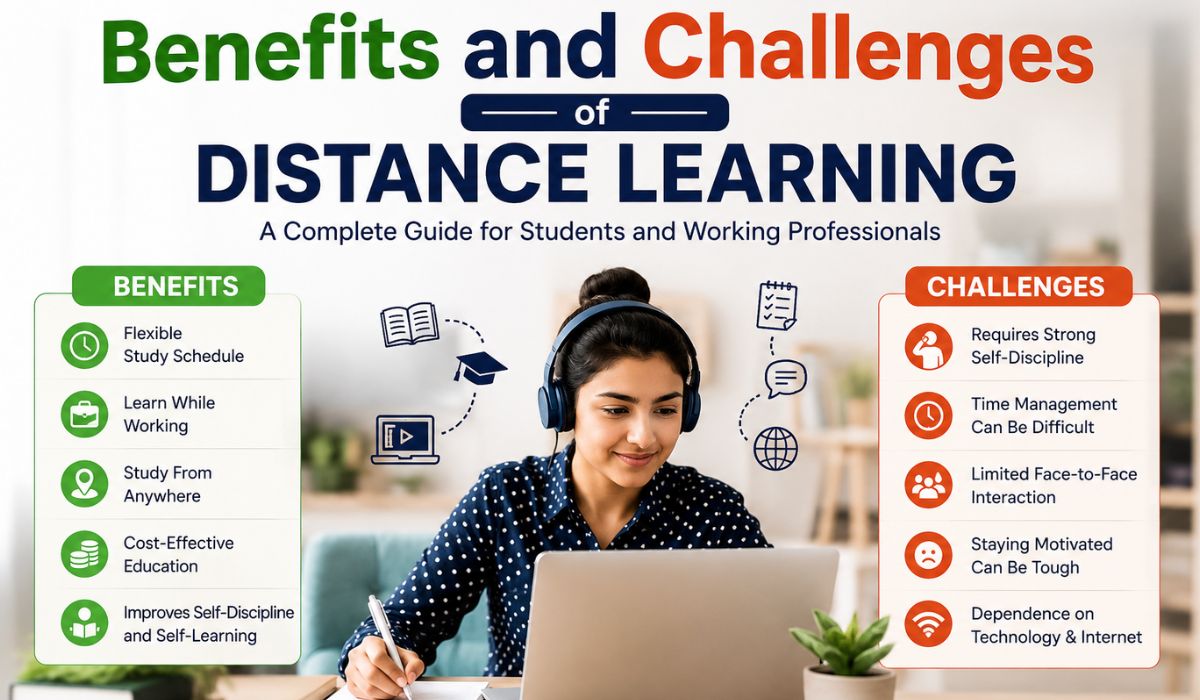
Distance learning has become one of the most popular ways for working professionals, MBA aspirants and self-motivated students to continue their education without pausing their careers. It allows students to study from home, manage their own schedules and access course material online rather than attending a fixed classroom every day. But flexibility alone does not guarantee academic success — distance learning also comes with real challenges around discipline, time management and exam preparation. Before choosing this mode of education, it helps to understand the benefits and challenges of distance learning together, rather than only the advantages. This guide looks at both sides objectively, and offers practical ways to manage the difficulties that most distance-learning students eventually face.
What Is Distance Learning?
Distance learning is a mode of education where students study away from a traditional campus, using online study material, recorded lectures, digital assignments and remote communication with their institution. Depending on the university, students may submit assignments online, attend occasional online or in-person sessions, and appear for scheduled examinations either online or at designated centres.
Some programs are largely self-paced, while others follow a structured academic calendar with fixed deadlines. Because these systems vary between universities, it’s worth checking your specific program’s format rather than assuming every distance-learning course works the same way. What stays consistent, however, is that distance learning shifts more responsibility for pacing and organisation onto the student compared to a traditional classroom.
Benefits of Distance Learning
What are the benefits of distance learning?
Distance learning offers flexibility, location convenience, independent study opportunities and the ability to balance education with professional or personal responsibilities. Below is a closer look at each advantage.
Flexible Study Schedule
One of the biggest draws of distance learning is the ability to study around work, family responsibilities and travel instead of a fixed timetable. A working professional putting in a full day at the office, for instance, can study in the evenings or on weekends rather than rearranging their job around lectures.
Learn While Working
Distance learning is especially attractive for distance learning for working professionals who want to add a qualification or switch career tracks without stepping away from employment. This means students can keep earning an income and gaining work experience while completing their degree, which also makes tuition and living costs easier to manage.
Location Flexibility
Because most course material, lectures and communication happen online, students can access a large part of their coursework without attending a physical classroom every day. This doesn’t mean every course can be finished entirely from home — some programs still require occasional in-person components such as exams or workshops, so it’s worth confirming this with your specific university.
Better Time Management
Distance learning gives students the freedom to build their own study routine, dividing time between work, assignments and exam preparation in a way that suits them. Over time, this can build a genuinely useful skill: the ability to plan and protect study time without external reminders.
Wider Choice of Courses
Because distance and online programs aren’t limited by campus geography, students often get access to a broader range of specializations and institutions than they might find locally. This is particularly useful for niche postgraduate specializations that may not be offered by a nearby college.
Develops Self-Learning Skills
Studying independently naturally strengthens skills like research, time management, self-discipline, problem-solving and digital communication. These are the same skills employers value, which is one reason many working professionals see distance learning as a practical investment beyond just the degree itself.
Can Be Convenient for Adult Learners
For people returning to education after several years in the workforce, a flexible learning model can feel far more manageable than sitting in a classroom with a fixed schedule. It allows adult learners to fit study around established routines, families and careers rather than restructuring their whole life around a course.
Challenges of Distance Learning
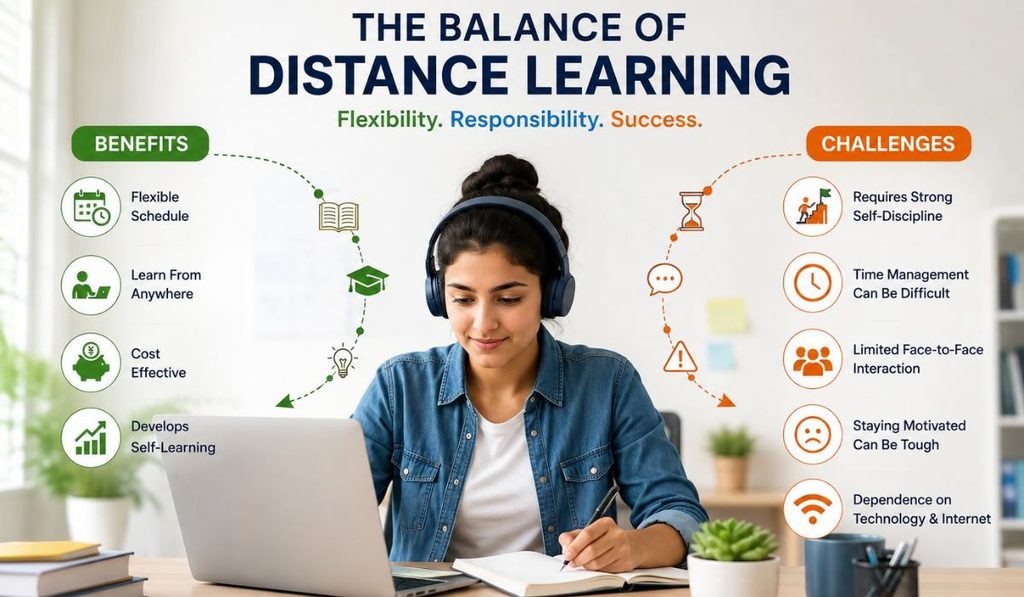
What are the biggest challenges of distance learning? The most common difficulties are self-discipline, time management, limited face-to-face interaction, staying motivated, meeting assignment deadlines and preparing effectively for exams without regular classroom guidance. Each of these is explained below.
Requires Strong Self-Discipline
Without a teacher taking attendance or a fixed class schedule, students are largely responsible for creating and sticking to their own study routine. This freedom is exactly what makes distance learning appealing, but it can also be the hardest part for students who are used to more structure.
Time Management Can Become Difficult
Balancing office work, family responsibilities, assignments, revision, exams and personal commitments all at once is genuinely demanding. Many students underestimate how much time consistent studying requires until deadlines start piling up.
Limited Face-to-Face Interaction
Some students miss the direct interaction with teachers and classmates that a traditional classroom offers, including the ability to ask questions in real time or discuss doubts informally. Depending on the institution, discussion forums, email support and scheduled online sessions can help bridge this gap, though they rarely replace in-person interaction entirely.
Difficulty Staying Motivated
Procrastination and inconsistent study habits are common, especially over the length of a full course. Without regular deadlines or classmates around for accountability, motivation can dip, particularly mid-course once the initial enthusiasm fades.
Assignment Deadlines
Distance-learning students often face several assignments with overlapping deadlines, which can be stressful if preparation starts too late. Understanding exactly what each assignment requires — the expected structure, word count and submission format — early on makes it far easier to plan around multiple deadlines instead of scrambling at the last minute.
Exam Preparation Can Be Challenging
Students who rely only on reading through course material can struggle to identify which topics matter most, how questions are typically framed, and how to structure answers within a time limit. This is where many students find that structured resources, such as SCDL exam preparation support, help them understand exam patterns rather than trying to guess based on the syllabus alone.
Technology and Internet Dependence
Distance learning depends on stable internet access, working devices and comfort with digital platforms, whether that’s a learning portal, video lectures or an online exam system. These issues are usually manageable with some preparation and aren’t unique to distance learning, but they’re worth planning for rather than assuming everything will work smoothly on the first try.
How to Overcome the Challenges of Distance Learning
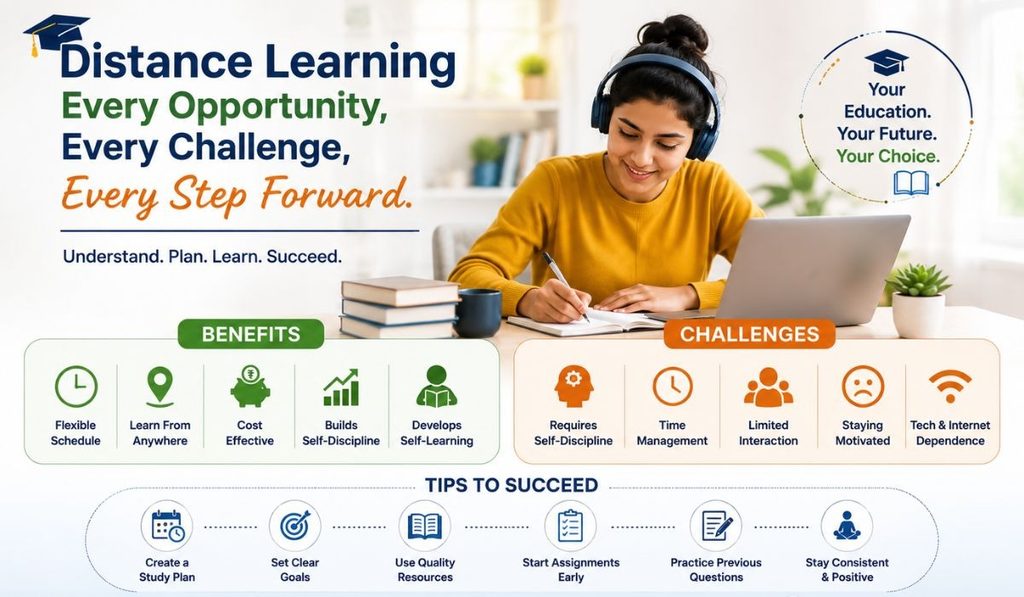
The good news is that most of these challenges respond well to a bit of planning. Here are some practical, actionable steps.
Create a Weekly Study Schedule
Block out fixed study slots across the week — for example, an hour on weekday evenings and longer sessions on weekends — rather than trying to “find time” whenever it appears. Treating these slots like fixed appointments makes them far more likely to actually happen.
Set Small Academic Goals
Break large subjects into smaller topics or chapters with their own mini-deadlines, instead of treating an entire course as one overwhelming task. Finishing smaller goals regularly also helps maintain motivation over a long course.
Start Assignments Early
Waiting until close to the deadline is one of the most common reasons assignments feel stressful. Starting early gives you room to research properly, ask questions if something is unclear, and revise your work before submission. If you’re studying under a specific program, resources such as SCDL assignments can help you understand what a particular assignment expects before you begin writing.
Practice With Previous Year Questions
Working through previous years’ question papers is one of the most effective ways to understand question formats, identify frequently tested topics, and practise structuring answers within a time limit. Resources like SCDL solved papers can help students see how answers are typically structured, which builds confidence heading into the actual exam.
Revise Before Exams
Set aside dedicated revision time before each exam period to consolidate what you’ve studied, rather than reviewing everything for the first time close to the exam date. Short, well-organised revision notes made throughout the course are usually far more useful than last-minute cramming.
Ask for Academic Help When Needed
There’s no reason to struggle silently through a difficult subject, a confusing assignment brief or an unfamiliar exam format. Reaching out for guidance — whether from your institution or from external academic resources such as NMIMS assignments support — can save considerable time and stress compared to figuring everything out alone.
Distance Learning vs Traditional Learning
| Factor | Distance Learning | Traditional Learning |
| Location | Flexible | Usually fixed |
| Schedule | Often more flexible | Usually structured |
| Classroom interaction | Limited/online | Direct |
| Self-discipline required | High | Shared with classroom structure |
| Commute | Usually reduced | Often required |
| Study style | More independent | More instructor-led |
| Flexibility for working professionals | Generally higher | Generally lower |
Actual experiences vary by institution and program, so it’s worth checking how a specific university structures its distance-learning courses before comparing it directly to a traditional one.
Is Distance Learning Right for You?
Distance learning tends to work well for someone who:
- Works full-time and needs schedule flexibility
- Can study independently without regular reminders
- Is comfortable using digital resources and online platforms
- Can manage deadlines without close supervision
- Has clear academic or career goals driving the decision
It can be more challenging for students who:
- Need consistent classroom supervision to stay on track
- Struggle with self-discipline or procrastination
- Strongly prefer face-to-face teaching and discussion
- Find independent study genuinely difficult to sustain
Neither mode of education is universally better — the right choice depends on your circumstances, learning style and how much structure you need to stay consistent.
How to Succeed in a Distance Learning Program
A simple framework can help: Plan → Study → Practice → Submit → Revise → Prepare.
- Understand your syllabus and course requirements early.
- Create a realistic study schedule you can actually maintain.
- Start assignments as soon as they’re assigned, not near the deadline.
- Practice important questions and previous-year papers regularly.
- Review solved papers to understand exam patterns and expectations.
- Prepare concise revision notes throughout the course, not just before exams.
- Track every examination and submission deadline in one place.
- Seek academic guidance whenever a topic or requirement is unclear.
Academic Support for Distance Learning Students
Even with good planning, most distance-learning students hit a point where they need extra support — whether that’s understanding an assignment brief, preparing for an unfamiliar exam format, or working through a project report. This is where academic-support resources like Navkim Solutions can be useful.
Navkim Solutions provides resources for distance-learning students around online assignments, solved question papers, exam preparation and project reports, including university-specific material for programs such as SCDL, SCOL, IMT CDL, SSODL, NMIMS, SMU and AMITY. For exam preparation specifically, resources like NMIMS solved papers are built around previous questions, common exam patterns and revision strategies rather than shortcuts. It’s worth noting that no academic resource can guarantee marks, guaranteed exam questions or a guaranteed pass — what these resources can do is help you prepare more effectively and understand what’s expected of you.
Frequently Asked Questions About the Benefits and Challenges of Distance Learning
What are the main benefits of distance learning?
The main benefits are flexibility, the ability to study while working, wider access to courses and institutions, better time management skills and convenience for adult learners returning to education.
What are the biggest challenges of distance learning?
The most common challenges are maintaining self-discipline, managing time across work and study, limited face-to-face interaction, staying motivated over a long course, and preparing well for assignments and exams without regular classroom guidance.
How can I manage assignments while studying through distance learning?
Start assignments early, understand exactly what each one requires before writing, and break the work into smaller stages instead of leaving it until close to the deadline. Program-specific resources can also help clarify what’s expected in unfamiliar assignment formats.
How can I prepare for distance learning exams?
Build a revision schedule well before the exam, focus on understanding rather than memorising, and practise previous year questions to get familiar with the format and typical time constraints.
Is distance learning difficult?
Distance learning isn’t inherently harder than traditional learning, but it does demand more self-discipline and independent planning since there’s less built-in structure. Students who plan ahead and seek help when needed generally find it manageable.
Conclusion
Distance learning offers real flexibility and accessibility, especially for working professionals and students juggling multiple responsibilities. But that flexibility only pays off when it’s paired with consistent planning, self-discipline and a clear approach to assignments and exam preparation. Understanding both the benefits and challenges of distance learning upfront makes it far easier to set realistic expectations — and to know when it’s worth reaching out for extra support. Explore Navkim Solutions for academic resources and support designed for distance-learning students.