
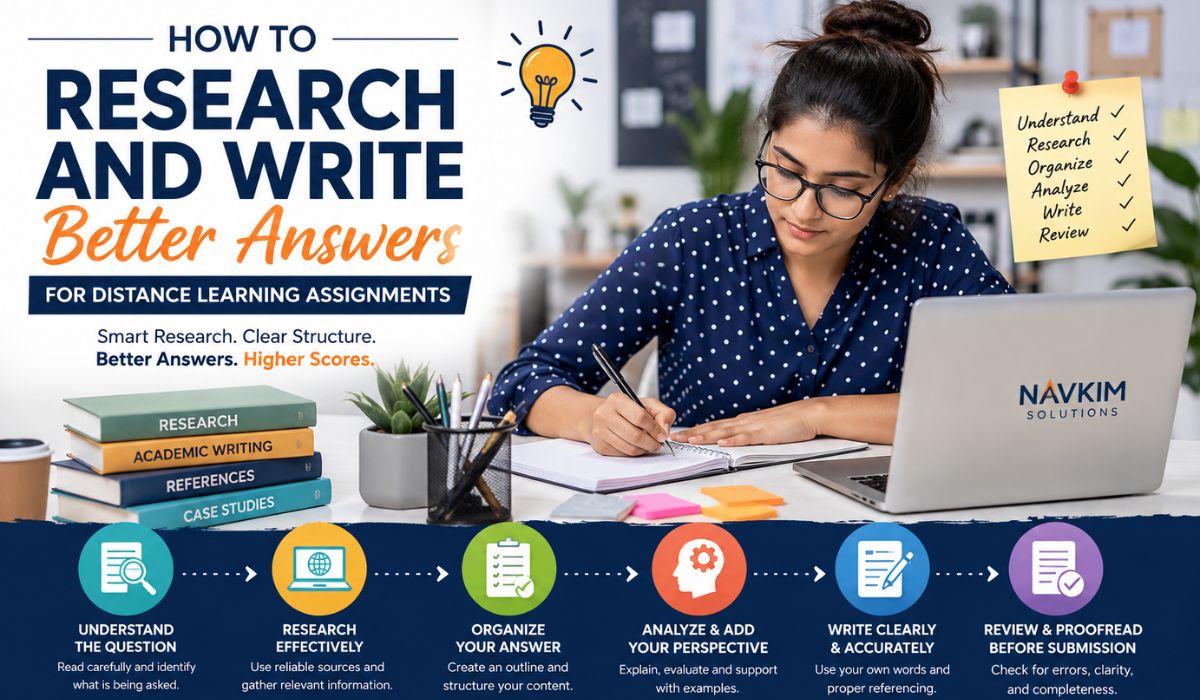
Balancing a job, a household, and coursework is the daily reality for most distance-learning students. Between meetings, deadlines, and family commitments, finding time for effective distance learning assignment writing can feel challenging. Researching a topic properly and turning that research into a clear, well-structured answer requires time, planning, and the right approach.
A common misconception is that a strong answer simply needs more words. In reality, it needs:
- A clear understanding of what the question is asking
- Research from reliable sources
- Ideas organized into a logical structure
- Concepts applied correctly, not just repeated
- Relevant, real-world examples
- Clear, original writing
- A final review before submission
This approach isn’t tied to one program. Whether you’re studying through AMITY, IMT CDL, SCDL, NMIMS, SMU, SCOL, or any other distance-learning university, the same core process helps you write more accurate, analytical, well-organized answers.
Why Research Matters in Distance Learning Assignments
Research is what separates a generic answer from a genuinely strong one. Done well, it:
- Builds real conceptual understanding, not just a surface-level idea
- Helps you support arguments with facts, data, or established theory
- Gives you examples and evidence to back up what you’re saying
- Improves the analytical depth of your answer
- Reduces vague, repetitive, or overly general responses
- Helps you answer the actual question asked, not everything you know about the topic
There’s a direct link between research quality and answer quality. Shallow research almost always shows up as a thin, descriptive answer — even with polished writing. Strong research gives you the raw material to write with depth, and it’s usually what separates an average submission from one that clearly demonstrates understanding.
Read and Understand the Assignment Question First
It’s tempting to start searching the moment you see an assignment. But research without a clear understanding of the question often produces answers that are only loosely connected to what was actually asked. Before opening a single source, read the question two or three times and identify exactly what it’s asking you to do.
Identify the Question Type
Assignment questions are built around instruction words, and each expects a different kind of answer:
- Define — give a precise, accurate meaning
- Explain — describe how or why something works, in detail
- Discuss — present different angles or perspectives
- Analyze — break a topic into its components and examine each
- Compare — identify similarities and differences
- Evaluate — weigh strengths and weaknesses and form a judgment
- Critically examine — question assumptions, don’t just describe
- Illustrate — use examples to make an abstract idea concrete
For example, “Explain organizational culture” expects a descriptive answer. But “Critically examine the impact of organizational culture on employee performance” expects you to question assumptions, weigh evidence, and form a judgment. Misreading the instruction word is one of the most common reasons students lose marks, even with solid subject knowledge.
How to Research for a Distance Learning Assignment
Once you know what the question requires, research becomes far more efficient.

Start With Your Course Material
Your first stop should always be resources provided by your university: official study material, prescribed textbooks, lecture notes, and other academic resources. This material is built around your syllabus, so it usually contains the core concepts and terminology your answer is expected to reflect. External sources should supplement this — not replace it. An answer that ignores the prescribed material in favor of outside sources alone can end up misaligned with what your evaluator is looking for.
Use Reliable Online Sources
Once you’ve covered the basics, expand your research using credible external sources: university websites, government publications, peer-reviewed research, recognized educational institutions, academic journals, and reputable industry reports.
To judge reliability, check who published the source, whether it cites its own references, how recently it was updated, and whether the information holds up across other credible sites. Be cautious with unattributed blogs or pages with no clear author or publisher — useful for a general sense of a topic, but not for the evidence that goes into your final answer. Students can also use Google Scholar to discover academic papers and research relevant to their assignment topics.
Compare Multiple Sources
Relying on a single webpage — even a good one — rarely gives a complete picture. Reading two or three sources on the same topic helps you spot arguments that appear consistently, differing viewpoints you might otherwise miss, and additional evidence that strengthens your answer.
How to Take Research Notes Without Copying
This is one of the most important skills in assignment writing, and one that’s easy to get wrong under time pressure.
There’s a real difference between researching a topic and copying from it. Research means understanding an idea well enough to explain it in your own words. Copying means reproducing someone else’s sentences with minor changes — which isn’t genuine paraphrasing. Swapping a few words for synonyms while keeping the original structure is still considered plagiarism by most academic standards.
A more reliable process:
- Read the source carefully.
- Make sure you understand the concept, not just the sentence describing it.
- Note the key idea in a few words.
- Close the source, or look away from it.
- Explain the idea in your own words.
- Add your own analysis or a relevant example.
- Cite the source wherever required.
This forces you to process information rather than transcribe it, which naturally produces original writing and a stronger grasp of the subject.
How to Structure a Strong Assignment Answer

Good research only pays off if it’s organized well.
1. Introduction
Introduce the topic, establish context, and briefly state what your answer will cover. Keep it short — this section orients the reader, it doesn’t make your full argument.
2. Main Discussion
Divide your answer into logical sections, using headings where appropriate. Within each, include short paragraphs, relevant examples, applicable theories from your course material, supporting evidence, and your own analysis connecting it back to the question.
3. Examples or Case Studies
Theoretical explanations become far more convincing with a practical example or case study. A well-chosen example shows you can apply a concept, not just recall it — exactly what “explain” and “analyze” are testing for.
4. Conclusion
Summarize your major points, directly answer the original question one more time, and tie the answer together. Avoid introducing new arguments here — the conclusion is for synthesis, not new information.
How to Make Assignment Answers More Analytical
Many students lose marks not because their information is wrong, but because their answer stays too descriptive.
Weak: Simply describing a concept in isolation.
Better: Explaining the concept clearly and adding a relevant example.
Strong: Explaining the concept, applying it to a situation, comparing it against another perspective, and reaching a reasoned conclusion.
To move from weak to strong, build your answer around these layers: explanation (what is it, in your own words?), application (how does it play out in a real scenario?), comparison (how does it relate to another idea?), evaluation (what are its strengths or limits?), and critical thinking (what’s your reasoned takeaway?). Even adding one of these layers to a descriptive answer noticeably improves its depth.
How to Use Examples in Distance Learning Assignments
Examples should earn their place — they’re there to demonstrate understanding, not pad the word count. One well-explained example beats three vague ones.
Depending on your subject, draw examples from business strategy, management, marketing, finance, HR, technology, or real-world organizations you’ve researched. The key skill is connecting a theoretical concept to a practical situation clearly: explain the concept, then show specifically how it applies to your example, rather than describing the two separately.
Referencing, Citations and Academic Integrity
Acknowledging your sources shows your answer is grounded in real research and helps you avoid plagiarism, which most universities treat seriously. A few practices worth building in: follow your university’s specific referencing format, since requirements can vary between programs; write in your own words rather than lightly edited source material; double-check quotations for accuracy and make sure paraphrased content is genuinely reworded; and keep a running record of sources while researching, so you’re not scrambling to find them later. Referencing rules can differ between universities, so check your own program’s official guidelines rather than assuming a general rule applies.
Common Mistakes Students Make When Writing Assignments
- Starting Without Understanding the Question — leads to answers that miss the requirement.
- Depending on One Source — results in a narrow, one-sided answer.
- Copying Online Content — risks plagiarism and shows a lack of original understanding.
- Writing Without Structure — makes even good research hard to follow.
- Using Irrelevant Examples — dilutes rather than strengthens the answer.
- Ignoring the Word Limit — underdelivers or pads with filler.
- Adding Too Much Filler — reduces the density of useful content.
- Forgetting References — can cost marks even when content is strong.
- Not Proofreading — leaves avoidable errors.
- Submitting Without a Final Checklist — increases the chance of missing a requirement.
How to Write Better Answers When You Are a Working Professional
If you’re studying while working full-time, the challenge usually isn’t understanding the material — it’s finding a sustainable rhythm. One example of how you might spread the work across a week:
- Day 1: Understand the question
- Day 2: Research from course material and reliable sources
- Day 3: Create a rough outline
- Day 4: Write your first draft
- Day 5: Review and improve
- Day 6: Check formatting and references
- Day 7: Final submission check
This isn’t a mandatory timeline — it’s one way to break a large task into manageable pieces instead of it all landing in the final 48 hours before the deadline.
When Study Resources and Solved Papers Can Help
Once you understand how research, structure, and analysis fit together, study resources and solved papers can be a genuinely useful part of your preparation. They can help with understanding how a strong answer is structured, identifying important concepts, seeing how different question types are approached, and checking whether your own understanding lines up with the expected answer.
The important distinction is in how you use them: solved examples work best as a learning resource — a way to see what a good answer looks like — rather than something to copy directly into your submission. Resources like distance learning solved papers can give you a sense of how solved answers are typically structured and referenced.
University-Specific Assignment Preparation
Assignment requirements — word limits, formatting rules, referencing styles, even question patterns — can vary considerably between universities and programs. It’s always worth checking your own course’s specific instructions before finalizing your approach.
That said, a starting reference point for your university can save time. AMITY students can refer to resources on AMITY assignment preparation to understand how online assignments for the program are typically approached, while IMT CDL students can use guidance on IMT CDL assignment preparation for reviewing assignment questions and building a structured preparation strategy.
For research and revision, previous-year papers can also help. AMITY students can refer to a collection of AMITY solved papers covering past assignment solutions and project reports — a useful reference while you work through your own research and writing.
Final Checklist Before Submitting a Distance Learning Assignment
- I understood the question correctly.
- I answered every part of the question.
- I used reliable sources.
- My answer has a clear introduction, body, and conclusion.
- I included relevant examples where appropriate.
- I explained concepts instead of merely copying definitions.
- My writing is in my own words.
- I included citations/references where required.
- I checked grammar and spelling.
- I followed the required format and word limit.
- I completed a final plagiarism/originality check where appropriate.
- I reviewed the university’s submission instructions.
FAQs
How do you research for a distance learning assignment?
Start with your official course material to understand the core concepts behind distance learning assignment writing, then expand your research using reliable external sources such as university websites, government publications, and academic journals. Compare multiple sources rather than relying on just one to develop a fuller, more balanced understanding of the topic.
What are the best sources for assignment research?
Prioritize your prescribed course material first, since it’s aligned with your syllabus. After that, look to university websites, government portals, peer-reviewed journals, and recognized educational publications, and be cautious with unattributed blogs or pages without a clear author.
How can I write better assignment answers?
Understand the question and its instruction word, research from reliable sources, organize your answer into a clear structure, and support your points with relevant examples. Aim to explain and apply concepts rather than just describe them, and leave time to review your final draft.
How do I avoid plagiarism in assignments?
Understand the source material well enough to explain it in your own words, rather than lightly editing the original sentences. Add your own analysis or examples, and cite sources wherever required — genuine paraphrasing reworks the idea, not just a few synonyms.
How should a distance learning assignment be structured?
A brief introduction that sets context, a main discussion divided into logical sections with examples and analysis, and a conclusion that summarizes your points and directly answers the question. Avoid introducing new arguments in the conclusion.
Can solved papers help with assignment preparation?
Yes, when used correctly. They can help you understand answer structure, identify important concepts, and prepare for exams more efficiently — best used as a learning reference for what a good answer looks like, not as content to copy directly.
How can working professionals manage assignment deadlines?
Breaking the work into smaller stages across several days — understanding the question, researching, outlining, drafting, and reviewing — is far more manageable than attempting everything at once, and leaves room for a proper final review before submission.
Writing a strong distance learning assignment ultimately comes down to a simple sequence: research, understand, organize, analyze, write, reference, and review. Following this process consistently — rather than looking for shortcuts — is what leads to answers that genuinely reflect your understanding of the subject. For students who want a starting reference point while building this process, Navkim Solutions offers study resources and solved examples across several distance-learning universities to support exam preparation and assignment research.