
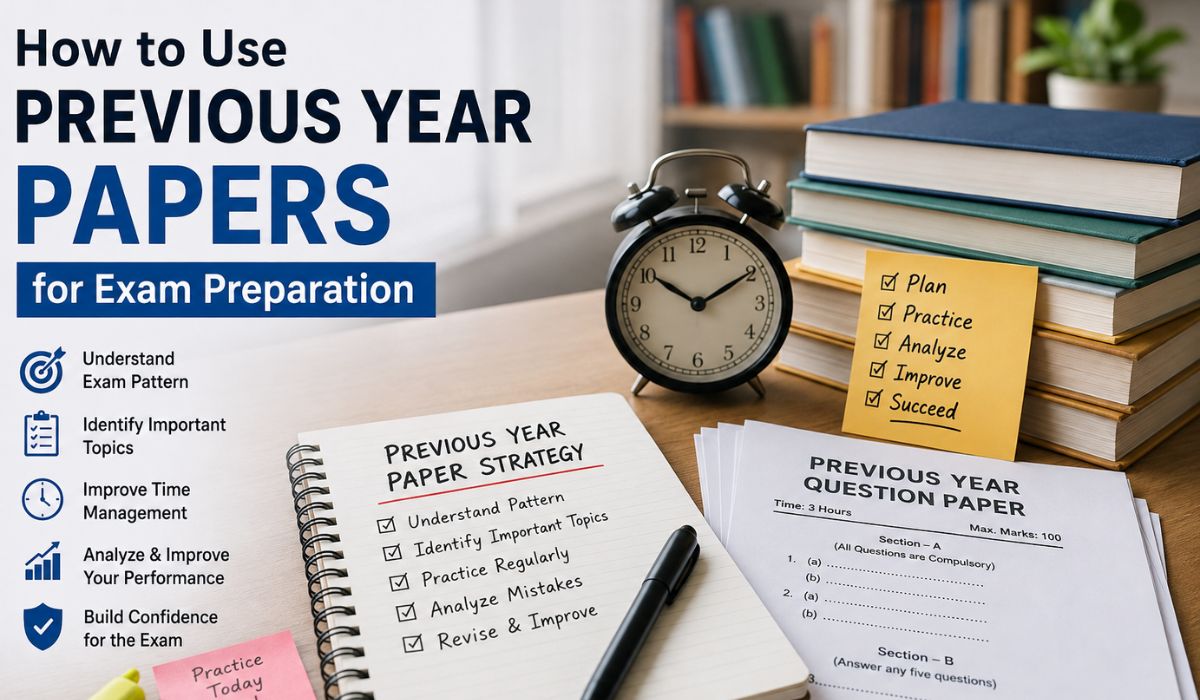
If you’re an online or distance-learning student, you’ve probably had this experience: you’ve read your study material two or three times, your notes are highlighted, and you still don’t feel ready. That’s normal. Reading course material repeatedly tells you that you’ve seen the content — it doesn’t tell you whether you can actually recall it under pressure, structure a full answer, or finish a paper on time. This is where previous year papers for exam preparation become genuinely useful. Instead of another round of passive reading, solving actual past papers shows you the exam pattern, the concepts that get tested most often, how difficult the questions really are, what a complete answer looks like, how long each section takes, and — most importantly — where your own weak areas are.
One thing to be clear about upfront: previous year papers are a study and practice resource, not a prediction tool. They can tell you a lot about how a subject is usually tested. They can’t guarantee which exact questions will appear in your next exam — and no genuinely reliable resource should promise that either.
Why Are Previous Year Papers Important for Exam Preparation?
Previous year papers matter because they turn an abstract syllabus into a concrete picture of what your exam will actually look like — the format, the difficulty, the pacing, and the topics that consistently get tested. Here’s what practicing with old question papers actually reveals.
1. Understand the Exam Pattern
Every university structures its papers a little differently. Going through a few previous year papers quickly shows you:
- The mix of objective and subjective questions
- How many questions you’ll need to attempt
- Whether there are long-answer or case-study components
- How marks are distributed across sections
Once you know the pattern, you can prepare answers in the format your examiner actually expects, instead of guessing.
2. Identify Important Topics
When you look at several papers side by side, certain topics tend to show up again and again. That doesn’t mean they’re guaranteed to appear next time — but topics tested repeatedly are usually core to the syllabus, so they’re a reasonable place to prioritize your revision.
3. Improve Time Management
Reading is untimed. Exams aren’t. Solving a full previous year paper under exam-length timing is one of the few ways to find out whether you can realistically finish every section — and which sections eat up more time than they should.
4. Identify Weak Areas
Every mistake you make while solving a past paper is useful information. A wrong answer, a skipped question, or a topic you couldn’t attempt at all tells you exactly where to focus your remaining study time, instead of revising everything equally.
5. Build Exam Confidence
A lot of exam anxiety comes from uncertainty — not knowing what to expect. Once you’ve worked through several previous year question papers, the exam stops being an unknown format and starts feeling like something you’ve already practiced.
How to Use Previous Year Papers Effectively
Finish your syllabus first, then work through past papers in stages — categorize, solve, check, and analyze — rather than jumping straight to memorizing old answers. Repeat that cycle across several papers instead of solving just one. Here’s the step-by-step version.
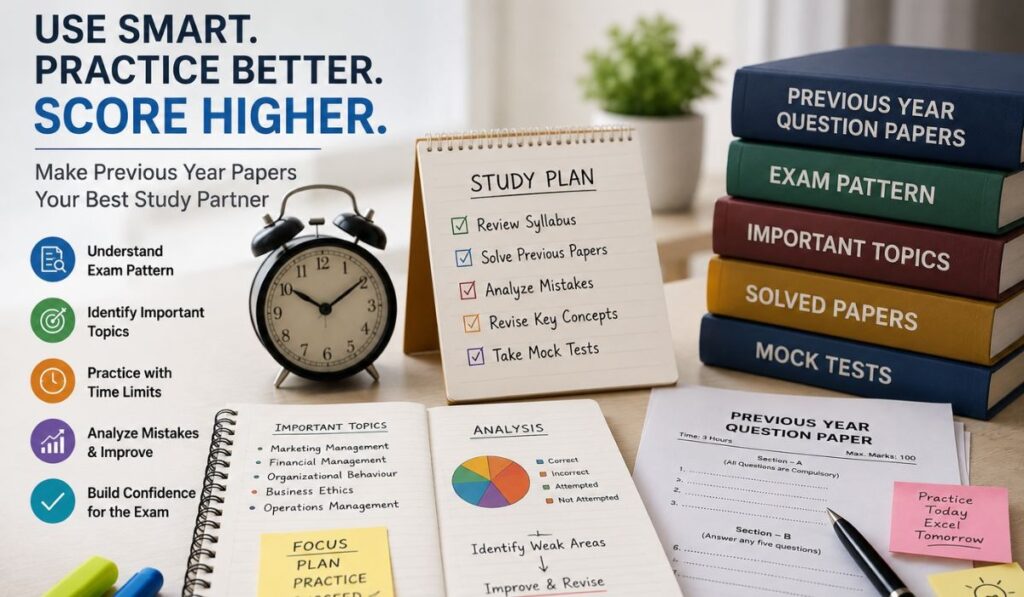
Step 1: Finish the Basic Syllabus First
Previous year papers work best as a test of understanding, not a substitute for learning the concepts. Go through your core material first, so that when you sit down with a past paper, you’re applying what you know rather than seeing it for the first time.
Step 2: Collect Multiple Previous Year Papers
One paper gives you one data point. Wherever possible, collect university previous year papers from several recent years for your subject. Comparing them gives you a far more reliable picture of exam trends than a single paper can.
Step 3: Categorize the Questions
As you go through the papers, sort the questions into simple groups:
- Frequently repeated topics
- Important concepts
- Difficult questions
- Easy questions
- Case studies
- Numerical problems
- Short-answer questions
- Long-answer questions
This turns a stack of old question papers into an organized study map.
Step 4: Compare Questions With Your Current Syllabus
Syllabi, subjects, and question formats change over time. Before you rely too heavily on an older paper, check that the topics it covers still match your current course structure. A great question from three years ago isn’t much use if that topic has since been dropped.
Step 5: Solve the Paper Without Looking at the Answers
Attempt the full paper on your own first, under exam-like conditions if you can. This is the step students skip most often — and the one that actually tells you where you stand.
Step 6: Check Your Answers
Once you’ve attempted the paper, compare your answers against reliable solutions or your own study material. Look for gaps in your understanding, not just right-or-wrong outcomes.
Step 7: Analyze Your Mistakes
Don’t just note that an answer was wrong — work through why. A simple framework helps:
Question → Mistake → Reason → Correct Concept → Revision
For example, a student might notice that questions on financial ratios show up in several previous papers. Rather than memorizing those specific answers, the more useful move is to revisit how the ratios are calculated and interpreted, then attempt a few similar questions independently to confirm the concept has actually sunk in.
Step 8: Repeat the Process
Treat previous year papers as practice tests, not one-time reading material. Solving a single paper once and moving on gives you far less than working through several, repeating the categorize-solve-check-analyze cycle each time.
How Many Previous Year Papers Should You Solve?
There’s no universal number that works for every student, and any resource that gives you one exact figure is oversimplifying. How many papers you should solve depends on:
- Your course and university
- How many papers are actually available
- How difficult the exam typically is
- How much preparation time you have
- How solid your existing understanding already is
A student with strong conceptual clarity might get real value from three or four well-analyzed papers. A student starting later might want more. What matters more than the count is how carefully you analyze each one — solving ten papers without reviewing your mistakes teaches you far less than solving four papers properly.
How to Analyze Previous Year Question Papers
A good analysis goes beyond checking which answers were right or wrong. Use this framework on every paper you solve:
| What to Check | What It Tells You |
| Repeated topics | Areas that deserve additional revision |
| Question types | Expected format |
| Marks distribution | Where to allocate preparation time |
| Difficult questions | Topics requiring deeper study |
| Frequently tested concepts | Potentially important areas |
| Time required | How to improve exam speed |
| Your mistakes | Personal weak areas |
Keep in mind that frequently appearing topics are useful signals, not guaranteed predictions. Use them to prioritize your revision — not to decide what to skip entirely.
Students preparing for NMIMS examinations can apply the same approach when reviewing NMIMS solved papers, particularly when comparing question patterns and commonly tested concepts.
How to Use Solved Papers Without Memorizing Everything
Solved question papers are genuinely useful — but there’s an important difference between learning from a solved paper and memorizing it.
Memorizing an answer helps you reproduce that exact answer, for that exact question, if it happens to repeat. Learning from a solved paper helps you answer any question on that topic, however it’s asked. The second approach is far more reliable.
A simple process keeps you on the right side of that line:
- Read the question.
- Attempt it independently, without checking the solution.
- Compare your attempt with the solution.
- Identify what you missed — content, structure, or both.
- Note how to improve your answer structure.
- Rewrite the answer in your own words, based on your own understanding.
That last step matters more than it looks. Copying a solved answer word-for-word might feel efficient, but it doesn’t build the understanding you’ll need if the question is asked differently — and it’s worth remembering that submitting someone else’s exact answers as your own original work is a step that can put your academic standing at risk, not just your exam score.
For students enrolled in AMITY programs, reviewing AMITY solved papers can provide additional practice with university-specific question formats.
Previous Year Papers vs Mock Tests: What’s the Difference?
They’re related, but they serve different purposes.
Previous year papers are useful for understanding historical exam patterns, identifying commonly tested concepts, and getting familiar with the actual style of questions your university asks.
Mock tests are useful for simulating the exam experience, practicing under real time limits, and testing where your current preparation actually stands — especially closer to the exam date.
Used together, they cover both sides of an exam revision strategy: previous papers show you what to expect, and mock test practice shows you whether you’re ready for it.
Students who need additional guidance while preparing for SCDL examinations can also explore SCDL exam paper help as part of their broader preparation strategy.
How Distance Learning Students Can Use Previous Year Papers
Online and distance-learning students are usually preparing under different constraints than full-time, on-campus students. Common challenges include:
- Studying while working full-time
- Limited, fragmented preparation time
- Self-directed learning with less classroom structure
- Multiple assignments running alongside exam prep
- Large volumes of course material to cover
- Exam anxiety after long gaps from formal exams
- Not knowing what to prioritize when time is short
This is exactly where previous year papers add the most value for distance learning exam preparation. Instead of trying to revise every unit equally, students can use past papers to identify which topics are consistently tested, focus limited study time there first, and build a routine that fits around work and other commitments rather than assuming unlimited study hours.
Students preparing for IMT CDL programs can also use IMT CDL solved papers to practice subject-specific questions and become familiar with previous examination patterns.
How to Create a Study Plan Using Previous Year Papers
Here’s one practical way to structure four weeks of preparation. Treat it as a starting point, and adjust the timeline based on how much time you actually have before your exam.
Review the syllabus and go through your core concepts.
Collect and analyze previous year question papers — categorize questions and spot patterns.
Practice topic-wise questions based on what your analysis showed you.
Attempt full previous year papers under timed, exam-like conditions.
This isn’t the only way to structure a study plan — adapt it to your own course, weak areas, and available time.
Common Mistakes Students Make When Using Previous Year Papers for Exam Preparation
- Studying only repeated questions. It narrows your preparation and leaves you exposed if the paper isn’t as predictable as you expected. Use repeated topics as a starting point, not the whole plan.
- Memorizing answers without understanding concepts. This breaks down the moment a question is phrased even slightly differently. Revise the underlying concept, not just the answer.
- Using outdated papers without checking the current syllabus. Always confirm a topic is still relevant before spending time on it.
- Looking at answers while attempting the paper. This defeats the purpose of testing yourself. Attempt first, check after.
- Ignoring difficult questions. Skipping what’s hard means you never close that gap — and difficult questions are usually where the most marks are lost.
- Not practicing under time limits. Untimed practice doesn’t prepare you for the pressure of a real exam. Time yourself at least a few times before the actual one.
- Solving papers without analyzing mistakes. Solving a paper and moving on without reviewing errors wastes most of its value.
- Depending entirely on previous papers. They’re a practice tool, not a replacement for your official syllabus and study material — use both together.
Where to Find Reliable Previous Year Papers
Start with official and verifiable sources: your university’s student portal or LMS, your program’s resource library, your academic coordinator or professors, and your college’s study centre. Many programs also circulate previous exam papers through official batch groups, or through seniors and alumni who’ve already completed the same course — these are often the most reliable and up-to-date sources for your specific syllabus.
Be cautious of anything that promises “guaranteed” results, claims to have current or leaked exam questions, or offers to complete assignments on your behalf. Beyond the academic-integrity risk of submitting work that isn’t your own, shortcuts like these don’t build the understanding you’ll actually need to perform in a real exam — and they can put your standing with your university at risk if discovered. When in doubt, cross-check anything you find against your official syllabus and your university’s current examination guidelines.
Frequently Asked Questions About Previous Year Papers for Exam Preparation
Are previous year papers useful for exam preparation?
Yes. They help you understand the exam pattern, identify frequently tested topics, and practice under realistic conditions. They work best alongside — not instead of — your regular syllabus and study material.
How do previous year question papers help students?
They reveal question formats, marks distribution, commonly tested concepts, and how much time each section typically needs, while also showing you your own weak areas through the mistakes you make while solving them.
How many previous year papers should I solve?
There’s no fixed number. It depends on your course, how many papers are available, your exam’s difficulty, and how much time you have. A few papers analyzed carefully are usually more useful than many solved carelessly.
Should I memorize answers from previous year papers?
No. Memorized answers only help if the exact question repeats. Understanding the underlying concept lets you answer the same topic no matter how the question is phrased.
Can previous year questions be repeated in exams?
Similar concepts or question styles can reappear, but you should never prepare on the assumption that a specific question will definitely be asked again. Treat repetition as a possibility, not a guarantee.
Should I solve previous year papers before completing the syllabus?
You can look through them early just to get familiar with the format. Serious, timed practice is more effective after you’ve studied the relevant concepts.
Are solved papers better than unsolved previous year papers?
They serve different purposes. Unsolved papers test what you actually know. Solved papers help you check your answers and understand where you went wrong. Using both gives you a more complete preparation cycle.
Final Takeaway
Previous year papers for exam preparation work best when they’re treated as a strategy and practice tool — not a shortcut. Used well, they follow a simple cycle:
Learn → Practice → Analyze → Revise → Retest
Start with your syllabus, use past papers to understand the pattern and test yourself honestly, analyze every mistake instead of just moving past it, and repeat the cycle as your exam gets closer. Whatever resources you use along the way, prioritize official, verified sources over anything that promises more than genuine preparation can deliver.