
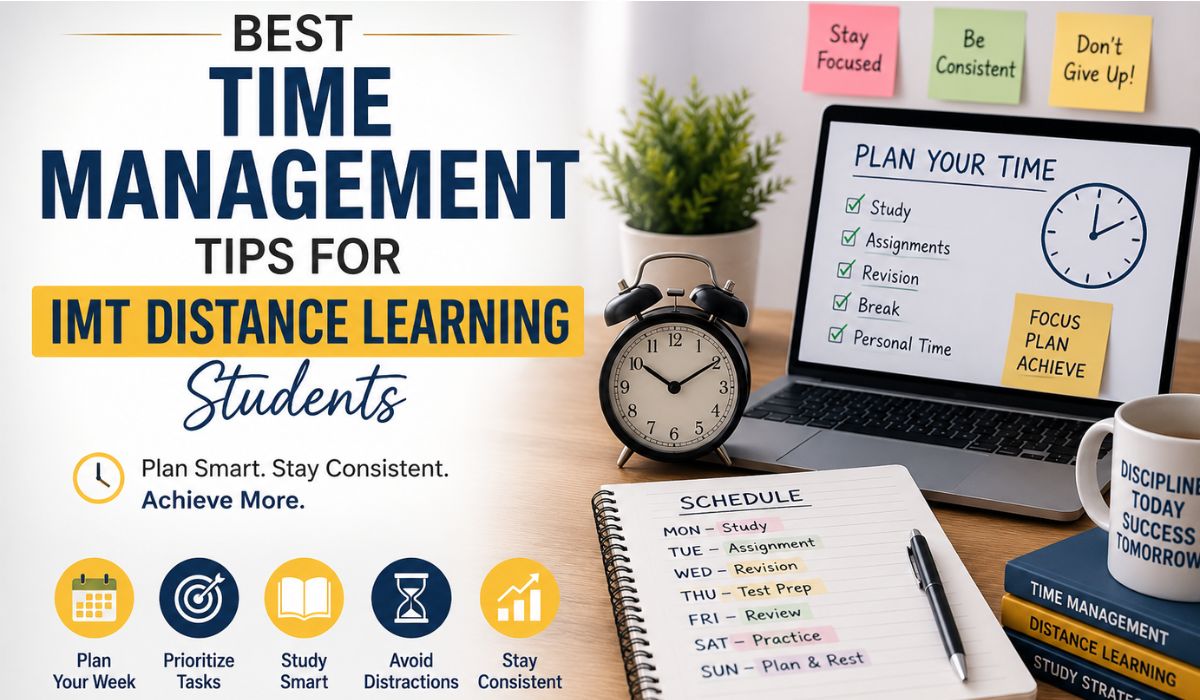
Distance learning offers flexibility, but that flexibility also comes with responsibility. Unlike a traditional classroom environment where lectures and academic activities follow a fixed daily schedule, distance learning students often need to manage their studies independently. For students who are also working professionals, balancing assignments, study material, examinations, professional responsibilities, and personal commitments can become challenging. Without a practical routine, academic tasks can easily accumulate until deadlines are uncomfortably close. Effective time management for IMT distance learning students is therefore less about studying for long hours and more about using available time strategically. With realistic planning, clear priorities, and consistent study habits, students can manage their academic workload without allowing it to interfere unnecessarily with other responsibilities.
This guide covers practical strategies that can help distance learning students create a more organised and sustainable approach to studying.
Why Time Management Matters in Distance Learning
Distance education gives students greater control over when and where they study. However, the absence of a traditional daily classroom schedule means students must create their own structure.
A typical distance learning student may need to manage several responsibilities at the same time, including:
- Reading course material
- Attending or reviewing online academic sessions
- Preparing assignments
- Conducting research
- Revising for examinations
- Managing professional responsibilities
- Handling family and personal commitments
Without proper planning, students may repeatedly postpone academic tasks because other responsibilities appear more urgent.
Good time management creates a system in which studying becomes a regular part of the week rather than something reserved for the days immediately before an examination or assignment deadline.
1. Understand Your Complete Academic Workload
The first step towards better time management is understanding exactly what needs to be completed.
At the beginning of an academic term or study period, review all available information about your subjects, assignments, examinations, and other academic activities.
Create a simple list of important tasks and deadlines. This may include assignment submission dates, examination schedules, important academic sessions, and personal study targets.
Instead of keeping everything in your memory, use a calendar, planner, spreadsheet, or task management application.
When your academic responsibilities are visible in one place, it becomes easier to plan ahead and avoid unpleasant surprises.
Always verify important dates through the latest official academic information available to you, as schedules and requirements may change.
2. Create a Realistic Weekly Study Schedule
One of the most useful time management tips for distance learning students is to create a weekly schedule based on your actual lifestyle.
A common mistake is designing an ambitious study timetable that is difficult to follow.
For example, a working professional may decide to study for three hours every evening after work. While this sounds productive, it may not be sustainable after a demanding working day.
A more practical schedule might include shorter weekday sessions combined with longer weekend study periods.
For example:
Monday: Review one chapter for 45 minutes.
Tuesday: Research one assignment question for 60 minutes.
Wednesday: Write the first draft of an answer.
Thursday: Review another subject.
Friday: Keep the evening flexible.
Saturday: Complete major assignment or revision tasks.
Sunday: Review progress and plan the following week.
The best study schedule is not necessarily the most intensive one. It is the schedule you can follow consistently.
3. Break Large Assignments Into Smaller Tasks
An assignment can feel overwhelming when viewed as one large project.
Instead of writing “Complete assignment” on your task list, divide the work into smaller actions.
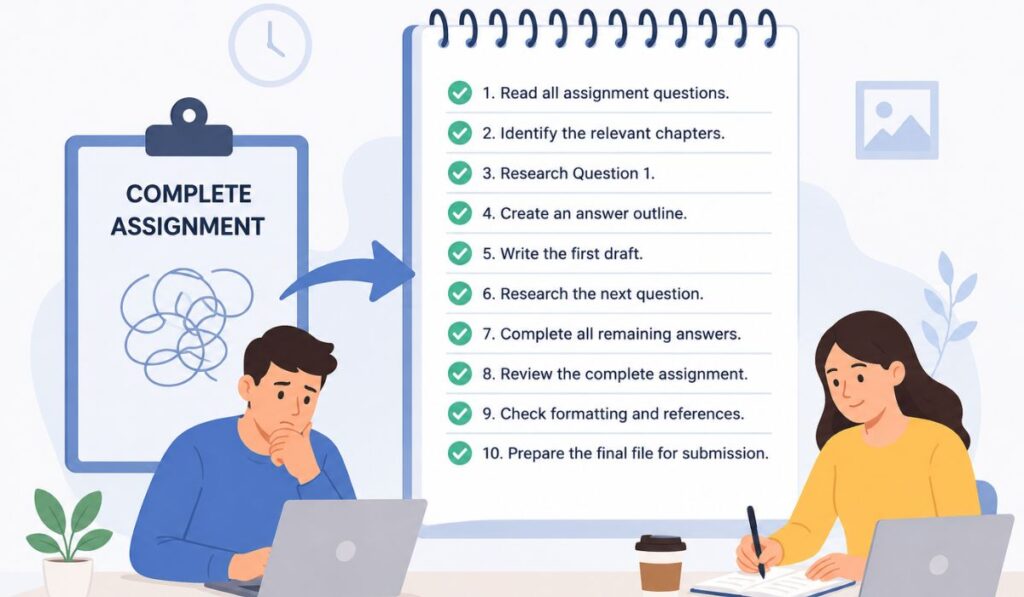
For example, your assignment plan could look like this:
- Read all assignment questions.
- Identify the relevant chapters.
- Research Question 1.
- Create an answer outline.
- Write the first draft.
- Research the next question.
- Complete all remaining answers.
- Review the complete assignment.
- Check formatting and references.
- Prepare the final file for submission.
Smaller tasks are easier to start, schedule, and complete.
This method also gives you a clearer picture of your progress. Even if you have only 30 or 45 minutes available, you can complete one small part of the assignment rather than postponing the entire project.
Students working on an IMT Project Report can use the same approach by dividing research, data collection, writing, editing, and final review into separate weekly tasks.
4. Prioritise Tasks Based on Deadlines and Difficulty
Not every academic task requires the same amount of attention.
Some assignments may require significant research, while others may be based primarily on concepts covered in the course material. Similarly, certain subjects may require more revision time because you find them difficult.
Prioritise your tasks by considering both urgency and complexity.
A task with a close deadline should generally receive immediate attention. However, a difficult assignment due several weeks later should not be ignored simply because the deadline appears distant.
Starting complex work early gives you more time to understand the topic and resolve difficulties.
At the beginning of each week, identify the three most important academic tasks you need to complete. Focus on those before spending significant time on lower-priority activities.
5. Use Short, Focused Study Sessions
Long study sessions are not always more productive.
When attention begins to decline, students may spend hours sitting with study material without actually absorbing much information.
Shorter, focused sessions can often be more effective.
You might study for 30 to 50 minutes and then take a short break before continuing. During the focused period, remove unnecessary distractions and concentrate on one specific task.
For example, instead of deciding to “study marketing,” set a specific goal such as:
“Read Chapter 3 and write notes on the key concepts.”
A clearly defined task makes it easier to measure whether the study session was productive.
6. Start IMT Assignments Early
Assignment deadlines can create significant pressure when students begin working only a few days before submission.
Starting early does not mean that you need to complete the entire assignment immediately.
Even reading the questions several weeks in advance can be useful. Once you understand what the assignment requires, you can gradually collect relevant information and plan your answers.
When managing IMT Assignments, consider setting a personal deadline several days before the actual submission date.
This provides extra time for:
- Proofreading
- Checking references
- Improving weak answers
- Correcting formatting
- Verifying the final document
- Handling unexpected technical issues
A personal deadline creates a useful buffer between completing the academic work and submitting it.
7. Make the Most of Small Time Gaps
Many students believe they need several uninterrupted hours before they can study effectively.
However, small periods of free time can also contribute to academic progress.
A 20-minute gap may not be enough to write an entire assignment, but it can be enough to read a concept, review notes, organise references, or create an outline for one answer.
You can match different tasks with the amount of time available.
Use shorter periods for reading, planning, and reviewing. Reserve longer uninterrupted periods for activities requiring deeper concentration, such as writing assignments or preparing for examinations.
Over an entire week, these small study sessions can add up to several productive hours.
8. Reduce Digital Distractions
Digital distractions are one of the biggest obstacles to focused study.
A quick check of a social media notification can easily turn into 20 minutes of unrelated browsing. Repeated interruptions also make it harder to return to a complex academic task.
During focused study sessions, consider:
- Silencing unnecessary notifications
- Keeping your phone away from your study area
- Closing unrelated browser tabs
- Avoiding social media until the session ends
- Using a separate browser window for academic research
You do not need to eliminate technology. The goal is simply to control when and how you use it.
Technology should support your study routine rather than repeatedly interrupt it.
9. Create a Dedicated Study Environment
Your physical environment can influence your ability to concentrate.
If possible, choose a regular location for studying. It does not need to be a separate home office. A quiet desk or organised corner can work effectively.
Keep essential study materials within easy reach so that you do not waste time searching for notebooks, documents, or course materials.
A consistent study environment can also create a psychological signal that it is time to focus.
If you regularly study in a noisy environment, headphones or a quieter location may help improve concentration.
10. Balance Work and Studies Strategically
For working professionals, balancing employment and education requires flexibility.
There will be weeks when professional responsibilities become unusually demanding. Similarly, assignment deadlines or examinations may occasionally require additional study time.
Instead of expecting every week to follow exactly the same schedule, adjust your study plan based on upcoming responsibilities.
Review your calendar at the beginning of each week.
If you know that work will be particularly busy on Wednesday and Thursday, complete more academic work earlier in the week or reserve additional time during the weekend.
Effective planning is not about following a rigid timetable regardless of circumstances. It is about adapting while keeping important academic responsibilities under control.
Students who find it difficult to organise their exam preparation can use IMT Exam Paper Help as academic guidance while creating a more focused revision strategy.
11. Avoid the Perfectionism Trap
Some students delay starting assignments because they want every sentence to be perfect immediately.
This can make writing unnecessarily slow.
When preparing an academic assignment, separate writing from editing.
During the first draft, focus on developing your ideas and answering the question. Once the main content is complete, return to improve the language, structure, grammar, and presentation.
A complete draft can be improved. A blank page cannot.
Setting reasonable standards for each stage of the process can help you make steady progress.
12. Review Your Progress Every Week
A study plan is only useful if you regularly evaluate whether it is working.
At the end of each week, spend a few minutes reviewing your progress.
Consider questions such as:
- Which tasks did I complete?
- Which tasks are still pending?
- Did I underestimate the time required for anything?
- Which subject needs more attention next week?
- Are any important deadlines approaching?
This simple weekly review can prevent small delays from developing into major backlogs.
If a particular study schedule repeatedly fails, adjust it rather than continuing with an unrealistic plan.
During revision, referring to IMT Solved Papers as study resources can help students understand question patterns and practise structuring their answers more effectively.
13. Keep Some Buffer Time in Your Schedule
Avoid planning every available hour.
Unexpected situations are normal. Work meetings may run late, family responsibilities may arise, or an academic task may take longer than expected.
If your schedule has no flexibility, one unexpected event can disrupt your entire week.
Keep at least one flexible study period available whenever possible.
You can use this time to complete unfinished work, catch up on reading, or revise difficult concepts. If you are already on schedule, the time can be used for additional revision or personal activities.
Buffer time makes your overall study plan more resilient.
14. Use Assignment Support Responsibly
Students sometimes need additional guidance when dealing with difficult academic topics or managing multiple assignments.
Educational resources, peer discussions, faculty guidance, reference materials, and IMT Assignment Help can be useful for understanding concepts and improving your approach to academic work.
However, external support should be used responsibly.
The purpose of academic assignments is to demonstrate your understanding. Reference materials should therefore help you learn, research, organise ideas, and develop your own answers rather than encourage direct copying.
Always follow the current academic integrity requirements applicable to your programme.
15. Build Consistency Instead of Depending on Motivation
Motivation changes from day to day.
Some days you may feel enthusiastic about studying, while on others you may find it difficult to begin.
A consistent routine reduces your dependence on motivation.
If you have already decided that Tuesday evening is your assignment research time, you do not need to make a new decision every Tuesday. The activity simply becomes part of your regular schedule.
Start with a manageable routine.
Studying consistently for five focused hours every week is generally more sustainable than studying for 15 hours one weekend and then doing nothing for the next two weeks.
Small, repeated efforts often produce better long-term results.
A Simple Weekly Time Management Plan
Here is a basic framework that distance learning students can adapt:
At the beginning of the week: Review deadlines and identify your top priorities.
During weekdays: Use shorter study sessions for reading, research, notes, and small assignment tasks.
During available longer sessions: Focus on writing assignments, complex topics, and examination preparation.
Before the weekend ends: Review completed tasks and move unfinished work into the following week’s plan.
Before important deadlines: Leave sufficient time for proofreading, final checks, and submission.
The exact schedule will differ from student to student. The important thing is to create a system that fits your actual responsibilities.
Common Time Management Mistakes to Avoid
Poor time management often results from habits that initially appear harmless.
Waiting until you “feel motivated” can delay important work. Setting unrealistic daily targets can lead to frustration. Constant multitasking can reduce concentration, while checking notifications repeatedly can consume valuable study time.
Another common mistake is ignoring distant deadlines. An assignment due in four weeks may not seem urgent today, but completing small parts of it each week is usually easier than handling the entire workload at the end.
Students should also avoid comparing their study schedules with others. Someone studying full-time will naturally have a different routine from a professional working eight or nine hours a day.
Your study plan should reflect your own circumstances.
Final Thoughts
Successful distance learning depends significantly on self-management. Students who plan their academic workload, start assignments early, minimise distractions, and maintain consistent study habits are better positioned to manage competing responsibilities.
The most effective time management for IMT distance learning students is based on realistic planning rather than an excessively strict timetable. Break large tasks into smaller steps, prioritise important deadlines, use focused study sessions, and review your progress regularly.
You do not need to study every available hour to remain organised. A practical routine followed consistently can make a significant difference.
Whether you are balancing a full-time job, personal responsibilities, or multiple academic subjects, the goal should be steady progress. Start with one manageable change to your current routine, follow it consistently, and adjust your approach as your academic workload changes.